
As single-use plastic waste continues to strain global ecosystems, post-consumer recycled (PCR) PE bags have emerged as a sustainable packaging solution, closing the loop on plastic’s lifecycle. Polyethylene (PE) is uniquely suited for recycling thanks to its chemical stability and low degradation rate during processing—pure PE materials boast a theoretical recycling rate of over 90%, with EU-compliant bags achieving a steady 75% actual conversion rate, far outperforming mixed-material alternatives. But what does the journey from a crumpled grocery bag to a new, usable product actually look like? Below is a detailed breakdown of the PE plastic bags step-by-step recycling process, including special considerations for composite PE blends, covering the full post-consumer recycled PE bags recycling process and post-consumer PE bags recycling steps.
Key Takeaways
- Proper source separation and targeted collection are non-negotiable for successful PE plastic bags step-by-step recycling, as soft PE bags can damage curbside sorting machinery if misdeposited.
- The post-consumer recycled PE bags recycling process includes rigorous cleaning and testing stages to ensure final products meet industry standards like the Global Recycled Standard (GRS) and EN15343:2008.
- Recycled PE bags production process can repurpose high-quality pellets into new packaging, while lower-grade materials may be used for energy recovery, maximizing resource efficiency.
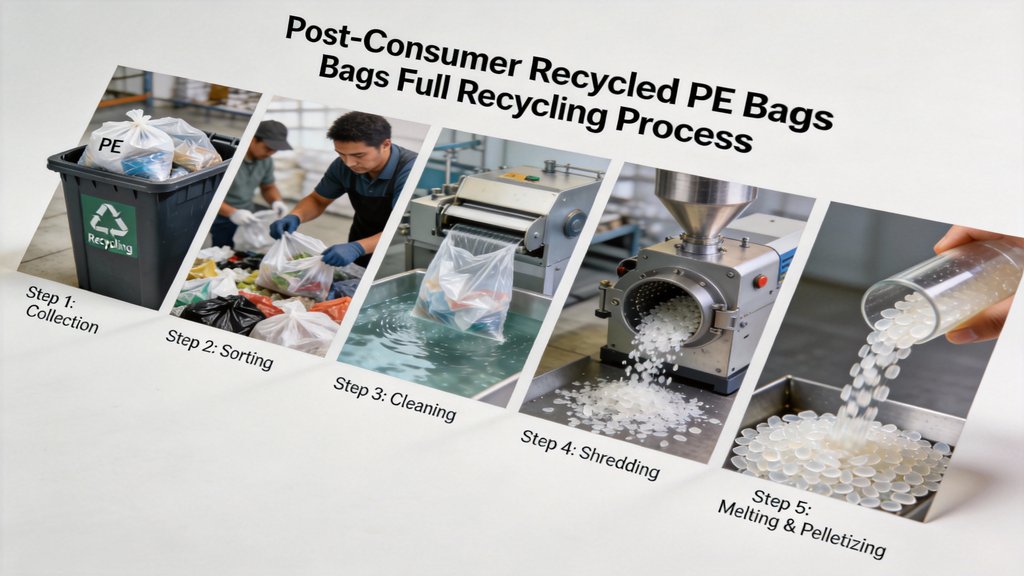
Stage 1: Source Classification and Targeted Collection – The Foundation of Effective Recycling
The post-consumer PE bags recycling steps begin long before PE bags reach a processing facility, with proper source separation being the foundation of success. Unlike rigid plastics, soft PE bags are not accepted in most curbside recycling bins in regions like Chicago and NYC, as they tangle with sorting machinery gears, causing costly shutdowns. Instead, consumers and businesses must deposit clean, dry PE bags at dedicated drop-off points, such as grocery store bins or industrial collection centers.
In recycling-mature regions like Germany, the dual-system DSD (Duales System Deutschland) collects over 800,000 tons of PE bags annually, achieving an 85% collection rate through community drop-offs, supermarket bins, and corporate bulk recycling programs. For PE/PE composite bags recycling process, it’s critical to ensure they meet standards like EN15343:2008, which verifies recyclable material composition and traceability, to avoid contaminating the recycling stream. Even small amounts of non-PE materials can compromise the entire batch, making this initial classification step make-or-break for the post-consumer recycled PE bags recycling process.
Stage 2: Sorting, Cleaning, and Size Reduction – Preparing PE for Processing
Once collected, PE bags are transported to a material recovery facility (MRF) for the next phase of PE plastic bags step-by-step recycling. First, workers or automated sorters separate PE bags from non-recyclable contaminants like paper, metal, glass, and non-PE plastics (such as PP or PVC bags). For PE/PE composite bags recycling process, advanced optical sorting technology may be used to identify and separate different PE layers, ensuring only compatible materials move forward.
After sorting, the bags undergo a pre-cleaning step to remove loose debris, paper labels, and residual food or dirt, often via manual inspection or low-pressure air blowers. Next, the sorted PE bags move to a mechanical cleaning line, where they are shredded into small, uniform pieces using industrial crushers. This size reduction increases surface area, making it easier to remove stubborn contaminants. The shredded PE pieces then enter a multi-stage cleaning process:
- Washing: Pieces are soaked in heated, soapy water to dissolve oils, food residue, and adhesives.
- Friction Cleaning: Rotating scrubbers agitate the pieces to scrub away embedded dirt.
- Rinsing and Drying: Cleaned pieces are rinsed with fresh water and dried using centrifuges or hot air blowers to eliminate moisture, which can cause defects during melting.
For heavily soiled PE bags, such as those used for food packaging, facilities may add a thermal washing step, using high-temperature water to break down tough contaminants. This stage is particularly critical for PCR PE bags, as clean raw material directly impacts the quality of the final recycled pellets used in the recycled PE bags production process.
Stage 3: Melting, Pelletizing, and Repurposing – Transforming Waste into Raw Material
Once dry and contaminant-free, the PE pieces are fed into an extruder, where they are heated to their melting point (around 120–180°C for LDPE and HDPE) as part of the post-consumer PE bags recycling steps. The molten plastic is then forced through a fine filter to remove any remaining micro-contaminants, such as small metal fragments or undissolved paper particles. This filtration step is essential for producing high-quality recycled pellets that meet industry standards like the GRS, which is trusted by brands like Nike, IKEA, and H&M for their recycled PE bags production process.
The filtered molten PE is then extruded through a die to form long, thin strands, which are cooled in a water bath and cut into small, uniform pellets (typically 3–5mm in length). These pellets, known as regranulates, are the primary raw material for new PE products. For lower-quality pellets that don’t meet manufacturing standards, they may be repurposed for energy recovery, such as burning in waste-to-energy plants to generate electricity, ensuring no material goes to waste in the post-consumer recycled PE bags recycling process.
Before being sold to manufacturers, the recycled PE pellets undergo rigorous quality testing to ensure they meet mechanical and chemical specifications. Tests include measuring melt flow rate (MFR), tensile strength, and color consistency, as well as verifying recycled content percentage for compliance with certifications like GRS or EN15343:2008. Once approved, the pellets can be used to produce a wide range of new products: high-quality pellets may be blown into new PE bags, shrink wrap, or agricultural films, while lower-grade pellets can be molded into durable items like park benches, trash cans, or drainage pipes. Some innovative facilities even process recycled PE into fiber for eco-friendly fabrics or construction materials, extending the material’s lifecycle further in the recycled PE bags production process.
FAQ
Q: Can I put PE bags in my curbside recycling bin?
A: In most regions, including Chicago and NYC, soft PE bags are not accepted in curbside recycling bins because they tangle with sorting machinery, causing costly shutdowns. Instead, deposit clean, dry PE bags at dedicated drop-off points like grocery store bins or industrial collection centers to support the post-consumer PE bags recycling steps.
Q: What makes PE/PE composite bags recycling process different from pure PE bag recycling?
A: PE/PE composite bags recycling process requires additional sorting steps to separate different PE layers, often using advanced optical technology, to ensure compatible materials are processed together. Pure PE bags have a theoretical recycling rate of over 90%, while composite blends may require more rigorous cleaning to maintain quality, though EU-compliant composite bags still achieve strong conversion rates.
Q: What products can be made from recycled PE pellets?
A: High-quality recycled PE pellets from the post-consumer recycled PE bags recycling process are used in the recycled PE bags production process to make new grocery bags, shrink wrap, and agricultural films. Lower-grade pellets can be molded into durable items like park benches, trash cans, and drainage pipes, while some facilities even repurpose them into eco-friendly fabric fibers or construction materials.
Conclusion
The post-consumer recycled PE bags recycling process is a highly structured, multi-stage system that turns waste into a valuable resource, covering every detail of PE plastic bags step-by-step recycling and addressing the unique needs of PE/PE composite bags recycling process. From source separation and targeted collection to cleaning, pelletizing, and reprocessing, each step plays a critical role in ensuring the final product meets quality and sustainability standards. By supporting dedicated PE bag recycling programs and choosing products made with PCR PE materials, consumers and businesses can reduce reliance on virgin petroleum, cut carbon emissions by up to 85% compared to new plastic, and contribute to a circular economy that keeps plastic out of landfills and oceans. As recycling technology continues to advance, the potential for PE bags to be recycled repeatedly, without losing quality, becomes increasingly achievable—proving that with proper systems in place, the recycled PE bags production process can turn plastic waste into a sustainable resource for generations to come.